
Charlotte CI Release Routes
Charlotte Correctional Institution is not part of Charlotte County Jail. It is an FDC prison at 33123 Oil Well Road in Punta Gorda. A true prison release can lead to the community with no state supervision, to probation or another form of post-prison supervision, or to another custodian when a detainer or legal hold applies. The term “discharge” should be reserved for the end of the applicable custody or supervision component shown by the responsible agency.
A movement to another FDC institution is not a release. The active Inmate Population record should change to the new location while custody continues. Likewise, a release from prison followed by an FDC Supervised Population record means incarceration ended but the person remains under a sentence component in the community. The release date must be read with the current custody field, sentence history, and supervision result.
| Charlotte CI event | Where the person appears | Meaning |
|---|---|---|
| Transfer to another FDC prison | Active Inmate Population at a new location | State prison custody continues |
| Scheduled future release | Active record and possibly Inmate Releases | A projection that may change |
| Completed prison release | Inmate Releases with a past Release Date | FDC prison custody ended |
| Release with state supervision | Inmate Releases plus Supervised Population | Prison custody ended; community supervision continues |
| Full state discharge | Release record with no current active or supervision match, confirmed as needed | The FDC components checked have ended |
Confirm Charlotte CI Releases
Use the FDC Inmate Releases database as the released-first source. Enter the six-character DC number when it is known because it is more precise than a name. Otherwise, enter the last and first names, use the alias option when needed, and compare birth date and sentence details. FDC says name matching is prefix-based. A shared name is not enough for a reliable match.
- Search Inmate Releases by DC number or name and open the matched detail.
- Record the DC number, custody field, Release Date, aliases, and relevant prison sentence history.
- Search the active Inmate Population data to rule out a transfer to another FDC location.
- Search Supervised Population with the same identifiers to determine whether community supervision follows prison release.
- If the date is in the future, treat it as scheduled and return after it passes for a completed event.
- Contact FDC Admission and Release or Central Records when the public result is missing, inconsistent, or too old for the question.
The official release form shows the fields used to begin a Charlotte CI discharge lookup.
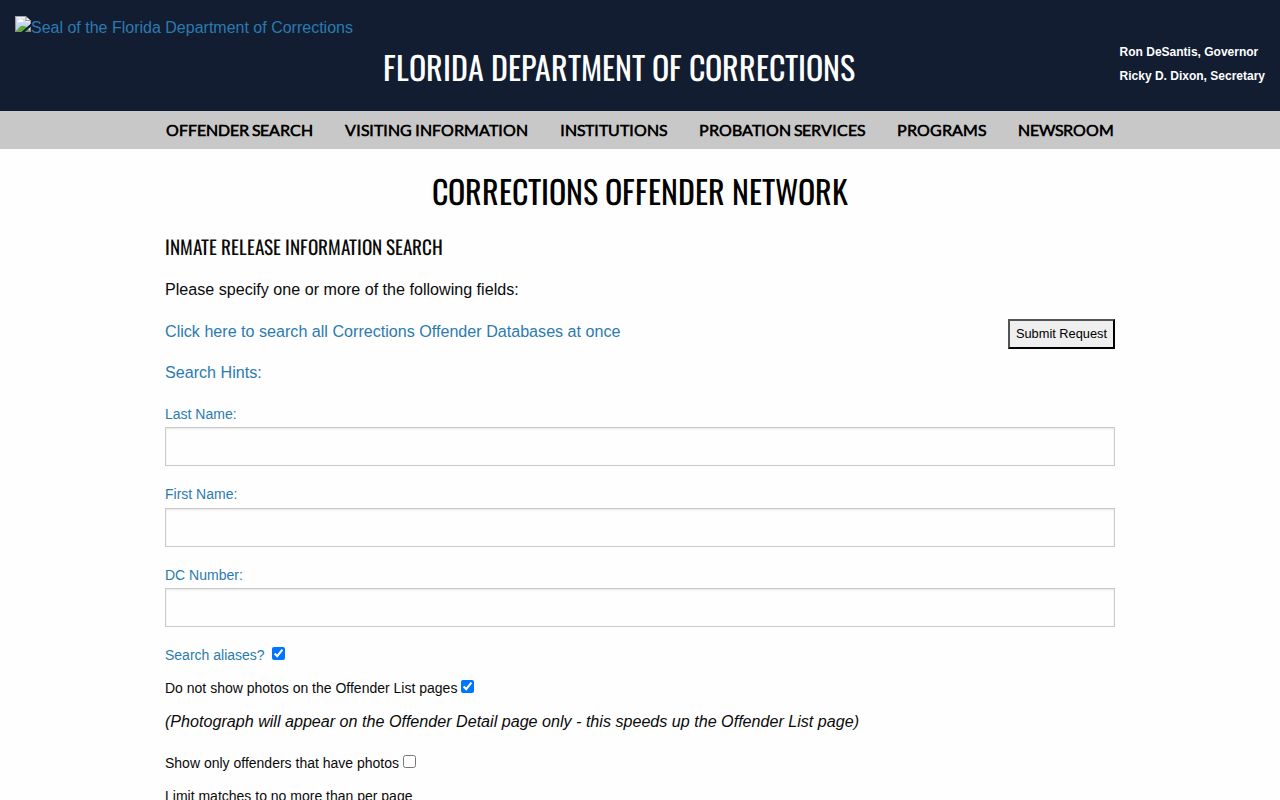
The form covers both people already released and people scheduled for release. That scope makes the detail record and date essential.
Note: A future date or an old screenshot is not proof that a Charlotte CI release was completed.
Charlotte CI Release Record Fields
FDC’s public released detail can show an offender photograph, DC number, name, race, sex, birth date, custody, Release Date, aliases, and prison sentence history. The public active record uses “Current Release Date.” Florida law calls the gain-time projection a “tentative release date.” Because the result page does not state that those labels are exact synonyms, the current date should be described as corresponding to the kind of tentative date calculated under section 944.275.
A released detail observed during the Charlotte research demonstrated a photograph and a past Release Date. It was used to confirm system behavior, not to make claims about the named person. The official FDC released-detail example shows how a completed record is laid out.
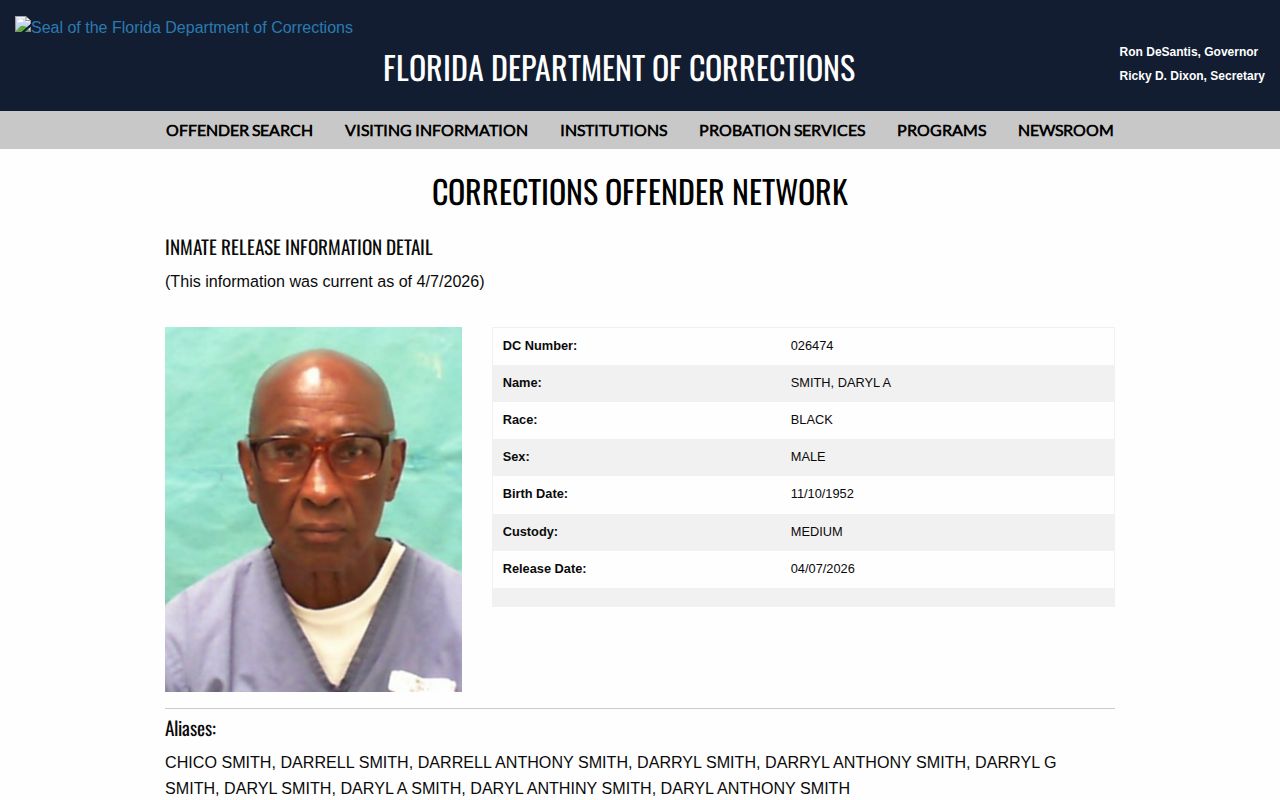
A past Release Date confirms departure from FDC prison custody when matched to the correct person. It does not, by itself, rule out supervision, a detainer, or custody by another authority.
- Current Release Date
- The changeable public date displayed on an active FDC record.
- Release Date
- The date displayed on the released detail for the matched release record.
- Detainer
- A notice or request tied to another authority that may affect where the person goes when FDC custody ends.
- Supervision
- A community sentence component that may continue after prison release.
Charlotte CI Release Date Rules
Section 944.275 governs FDC gain time and the tentative release date. FDC calculates a maximum sentence expiration date and reduces it through lawful credits. Grants or restored gain time may move the tentative date earlier. Forfeiture may move it later. For offenses committed on or after October 1, 1995, incentive gain time may reach ten days per month when the person and offense are eligible, but awards cannot produce release before at least 85 percent of the imposed sentence has been served. Court-awarded credit for physical incarceration counts toward that threshold.
The 85-percent rule is not a universal release formula. Offense date, excluded offenses, mandatory minimums, jail credit, consecutive or concurrent terms, extra sentences, discipline, detainers, lawful corrections, and life terms can affect the result. Section 921.002 also limits Criminal Punishment Code sentences to allowed incentive or meritorious gain time and states that parole under chapter 947 does not apply to people sentenced under that Code.
Most modern Charlotte CI dates are gain-time, sentence-expiration, or conditional-release issues rather than parole. Florida effectively abolished parole for offenses committed on or after October 1, 1983, with older and narrow exceptions. When FCOR action applies, an agenda or presumptive date is not enough. The Commission action must be followed by the eventual FDC release record.
Charlotte CI Post-Release Supervision
After a past Release Date is found, search FDC Supervised Population using the same DC number or identity. A matched detail can show supervision begin date, current status, supervision type, scheduled termination date, current location, aliases, and sentence history. The research observed a state example where supervision began on the same date as prison release, showing how the two databases can document a custody-to-supervision transition.
Circuit 20 serves Charlotte, Collier, Glades, Hendry, and Lee counties and includes FDC Office 203 in Punta Gorda. That does not mean every person released from Charlotte CI reports there. Placement can depend on the approved release address and assignment. Confirm the office through the record or FDC before directing a person to a location.
FDC Punta Gorda Office 203
121 E. Marion Avenue, Suite 125
Punta Gorda, FL 33950-3635
Phone: 941-575-5740
Fax: 941-575-5743
FDC supervision contact: 850-717-3444
co-supervision@fdc.myflorida.com
Probation, conditional release, parole, and full discharge are different labels. State the exact supervision type shown by FDC or FCOR rather than reducing each one to parole.
Charlotte CI Records and Contact
The current stable research source identifies Charlotte Correctional Institution as an FDC prison at the address below. The research did not verify a facility phone number or public office hours, so none is supplied. A current FDC PREA audit was the stable facility citation after an institution-list numeric link rendered inconsistent content during research. Release questions should go through the documented FDC records contacts.
Charlotte Correctional Institution
33123 Oil Well Road
Punta Gorda, FL 33955
Operator: Florida Department of Corrections
Bureau of Admission and Release: 850-488-9167
dc.release@fdc.myflorida.com
Central Records: 850-488-9859
Ask by DC number for the smallest record that resolves the issue, such as the release or discharge event, sentence history, and public detainer or transfer information. FDC’s OBIS data includes aliases, offenses, detainers, incarceration history, and release-cohort material. Public online release coverage begins October 1, 1997. Older or nonpublic records require an inquiry.
The FDC OBIS records page explains the data source and public-record route.
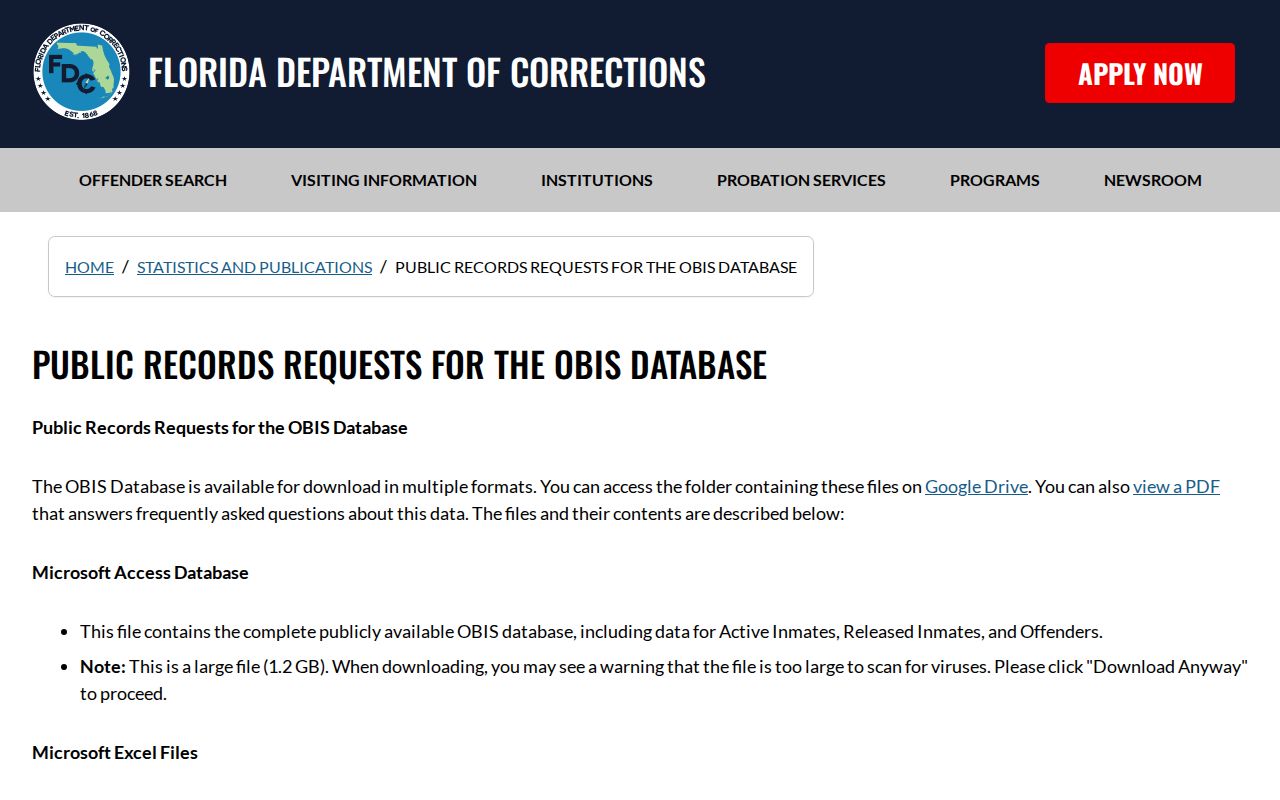
OBIS monthly downloadable data generally updates near the first of the month, which is slower than the nightly public release-search update. Use the channel that fits the needed date.
Note: Sealed, expunged, confidential, or otherwise exempt information may be removed or withheld from public FDC data.
Charlotte CI Is State Custody
The Charlotte County Local Arrest Database is the correct starting source for Charlotte County Jail bookings and releases, not Charlotte CI. A county conviction does not guarantee an FDC record. Short county sentences and pretrial detention remain local. Conversely, a person sentenced to state prison can have a Charlotte County court case while the custody record belongs to FDC.
Federal and immigration custody also require separate systems. Charlotte County Jail houses some federal detainees under a USMS contract and has a county-specific ICE relationship, but those facts concern the county jail pathway. They do not turn Charlotte Correctional Institution into a federal or ICE facility. If another authority receives a person after FDC release, verify the receiving custodian separately.
The Charlotte County released inmate records overview compares the county jail, Florida prison, federal, and immigration paths. Use it when the facility or receiving agency is uncertain. For Charlotte CI itself, FDC remains the controlling source for prison location, projected date, release event, and state supervision.