
Charlotte County Jail Release Routes
Charlotte County Sheriff's Office, Bureau of Detention, operates the jail as the county's main booking and release point. A local detainee may return to the community after bond, a first-appearance order, pretrial release, or completion of a county sentence. The event should produce a date and reason in the booking or release record. The related court docket supplies the case outcome and any continuing conditions.
Other exits are transfers. A person may go to the Florida Department of Corrections, another county, a federal authority, or ICE. A transfer ends the Charlotte County Jail confinement but continues custody elsewhere. Ask for the receiving-agency field when it is public. Then check that agency's system. Never treat absence from the jail's displayed population as proof of community release.
| Jail exit | Likely next source | What to confirm |
|---|---|---|
| Bond or pretrial release | CCSO release record and Clerk docket | Release time, reason, and pending case |
| County sentence complete | CCSO release record and judgment | Time served or sentence expiration |
| FDC transfer | FDC Inmate Population | Active state prison location |
| Federal movement | Federal docket, USMS, then BOP if applicable | Which federal authority controls custody |
| ICE handoff | ICE Online Detainee Locator | Current or recent immigration custody |
Confirm Charlotte County Jail Release
Start with the CCSO Local Arrest Database. It is a historical booking destination rather than a current-only roster. Search the full name, compare the birth date and booking date, and open the correct event. Look for an affirmative release date and release reason. The embedded database blocked the research session, so live labels and controls should be read as they appear rather than assumed from an old copy.
- Search the official county database and identify the right booking.
- Record the date confined, date released, and release reason.
- If the result is blocked or absent, call the jail at 941-833-6300.
- For release or transfer paperwork, call Detention Watch Commanders at 941-833-6357.
- Request the release screen when a document or transfer destination is needed.
- Check the receiving agency if the record describes a transfer.
The official CCSO database entry page identifies the right county system.
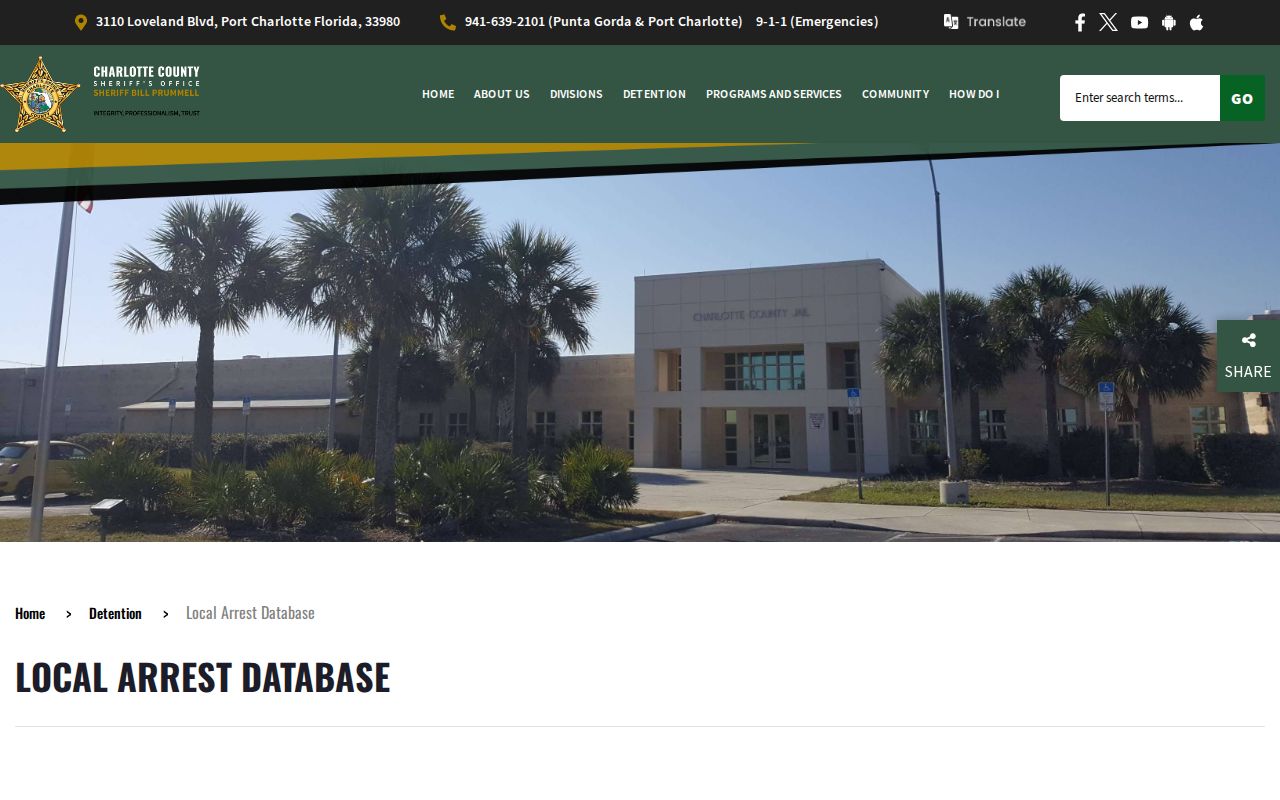
The outer page alone does not confirm release. The matched booking needs a date and reason, or detention staff must verify that the paperwork is complete.
Charlotte County Jail Release Records
Detention Watch Commanders are the most release-specific phone contact documented by CCSO because the agency says they review booking, release, and transfer paperwork. Telephone staff may limit protected details, and a call is not a certified record. Use the formal public-record route when exact dates, transfer fields, or a copy matter.
Charlotte County Jail26601 Airport Road
Punta Gorda, FL 33982
General jail: 941-833-6300
Detention Watch Commanders: 941-833-6357
Submit a public-record request through CCSO JustFOIA or address it to the Custodian of Public Records, Charlotte County Sheriff's Office, 3110 Loveland Boulevard, Port Charlotte, FL 33980. Give the full name, date of birth if known, booking or JCA number, and arrest date. Ask for the date and time confined, date and time released, release reason, charge and bond fields, and any public transfer destination. Request an estimate before special-service work.
Florida section 119.07 requires prompt acknowledgement and a good-faith response but sets no fixed production deadline for this request. Confidential or exempt details may be redacted. CCSO's records page describes reasonable inspection times as 8 a.m. to 5 p.m. A precise request is easier to identify and review than a demand for the whole jail file.
Charlotte County Jail Release Timing
The jail publishes no fixed daily release time, named release door, weekend schedule, or guaranteed pickup procedure in the reviewed material. The Twentieth Judicial Circuit offers a narrower local rule: after a judge orders release, processing usually takes a few hours, often after monetary bond. Holds, other cases, identity work, receipt of funds, and receiving-custody issues can change that timing.
A released person is afforded a jail phone call to arrange transportation. Family should call before traveling to Airport Road because a court order or bond payment does not mean the release desk has finished. Charlotte County Transit is fare-free, shared-ride, and curb-to-curb, not an on-demand jail shuttle. It recommends advance booking, depends on service-area coverage and available capacity, and is closed Sundays and recognized holidays.
Note: Confirm paperwork completion directly with Charlotte County Jail before arranging pickup, since no published gate time guarantees a physical release.
Charlotte County Jail Custody Scale
The Charlotte County Jail opened in February 2001 and uses direct supervision, a model in which staff work within the residential units. CCSO reports a rated capacity of 1,074 beds, with 913 general-population beds after reserving space for classification and placement needs. The facility also has a video courtroom for first appearances, arraignments, and bond hearings.
These annual figures show substantial turnover but do not describe current custody. CCSO also reported adult, juvenile, weekender, local, state or other, and federal populations. That varied legal custody is why each departure needs a release-reason and receiving-agency check.
Property After Charlotte Jail Release
The 2026 inmate handout says booking includes fingerprints, photographs, classification, phone calls, and an inventory of personal property. Stored property can be released through a notarized form. When a person is sentenced to FDC, family has 90 days to retrieve property. An unreceived commissary order after release is held for 30 days under CCSO's funds guidance.
Those deadlines do not prove custody status. Ask staff what identification and form are required, then refer to the booking number so the property can be matched to the correct event. If the person transferred to FDC, treat that as continued state custody even though the county property clock has started.
Charlotte Jail Release or ICE
Charlotte County Jail has a locally important immigration-custody layer. A current 2025 agreement connects ICE and CCSO through the 287(g) Task Force Model. ICE also explains that a detainer can support a transfer after ordinary criminal custody ends. Neither fact proves that a named detainee entered immigration custody. They explain why the possibility must be checked.
Search the ICE Online Detainee Locator by a nine-digit A-number and country of birth, or exact name and country of birth with an optional birth date. ICE says ODLS covers current detention and recent ICE releases for about 60 days. If the person is absent, the information line at 1-888-351-4024 operates weekdays, excluding holidays, from 8 a.m. to 8 p.m. Eastern. A county release followed by ICE custody is a transfer, not freedom.
Charlotte Jail Federal Release Checks
USMS contract detainees are held inside Charlotte County Jail rather than in a separate county federal building. CCSO's 2025 report counted 245 federal bookings and an average of 95 federal inmates. A person who leaves Airport Road may therefore remain in federal custody or move for a hearing, designation, or sentence.
For a pretrial federal case, check the federal docket and the U.S. Marshals Service. The USMS Middle District of Florida Fort Myers office is 239-286-6844 for appropriate custody inquiries. After federal sentencing and designation, the Bureau of Prisons locator becomes more useful. A BOP result with a past date and “Released” or “Not in BOP Custody” confirms departure from BOP, not the absence of supervision or another custody system.
Charlotte Jail History and Releases
The direct-supervision facility has served Charlotte County since 2001. A current renovation project addresses aging kitchen, laundry, and plumbing systems into 2027. No reviewed county source ties that construction to a changed release route, release window, or family pickup policy. The safer local distinction is legal custody, not construction activity.
Local detainees, state or other holds, and federal contract detainees share the Charlotte building under different authorities. That mix makes the release record's reason and destination more valuable than a roster snapshot. The Charlotte County released inmate search brings the county, FDC, court, VINE, federal, and immigration paths together when the destination is unclear.
Prove Charlotte County Jail Release
A sound proof packet uses two records. For a bond release, pair the CCSO release screen with the Charlotte Clerk docket. For a state transfer, pair the county release or transfer field with the active FDC location. For federal movement, use the federal docket or USMS with the jail record. For an ICE handoff, compare the county event with ODLS or ERO confirmation.
If the Local Arrest Database does not open, move to the phone and records-request fallbacks. If staff can confirm status but cannot disclose details, request the smallest public record that answers the question. A release date without a reason may leave transfer unresolved. A reason without a completion time may leave pickup premature. The strongest Charlotte County Jail result identifies the person, date and time, release basis, and any receiving authority.