
Charlotte Projected and Actual Release
Florida law uses “tentative release date” for the state-prison projection calculated under section 944.275. FDC’s active public record displays a “Current Release Date.” The public label and the statutory term describe closely related parts of the release calculation, but FDC does not state that the phrases are verbatim synonyms. The safest reading is that the displayed current date corresponds to the kind of tentative date computed under the statute.
An actual release date records a completed custody event. It appears only after the custodian processes the departure and updates its system. For an FDC prisoner, a past Release Date in Inmate Releases is stronger evidence than an old active-record projection. For Charlotte County Jail, a Date Released plus Release Reason can distinguish bond, time served, or transfer. Roster disappearance alone cannot.
| Record | What it can establish | What it cannot establish alone |
|---|---|---|
| FDC active record | Current location, sentence history, and Current Release Date | That release has already occurred |
| FDC Inmate Releases | A released or scheduled record, Release Date, custody details, and sentence history | That all supervision or another agency’s custody ended |
| CCSO release record | Date and reason Charlotte County Jail gave up custody | Community freedom if the reason is a transfer |
| Court docket or judgment | Sentence, credit, bond order, disposition, and later orders | The hour the release desk finished processing |
Find Charlotte Inmate Release Dates
Start with custody type. Charlotte Correctional Institution is an FDC state prison, so use FDC records. Charlotte County Jail holds pretrial detainees, people serving county sentences, and people held for other authorities. A county jail departure can lead to the community, FDC, another county, USMS, or ICE. Only the record’s release reason or receiving agency can resolve that difference.
- Identify whether the person is at Charlotte County Jail, Charlotte Correctional Institution, another FDC prison, or a different custodian.
- For an active FDC prisoner, search by the six-character DC number when available and record the Current Release Date plus the page’s currency notice.
- Review sentence and offense dates in the FDC history and court judgment because credit rules depend on those dates.
- For a county sentence, ask CCSO for the booking/release screen and use the Charlotte Clerk record to confirm the sentence and jail credit.
- For a pretrial case, check the court order, bond status, holds, and jail processing rather than looking for a gain-time projection.
- After the date passes, search the completed release record and then check whether supervision or another custody layer continues.
The FDC all-databases search is the broad starting point when the correct FDC record set is not yet known.
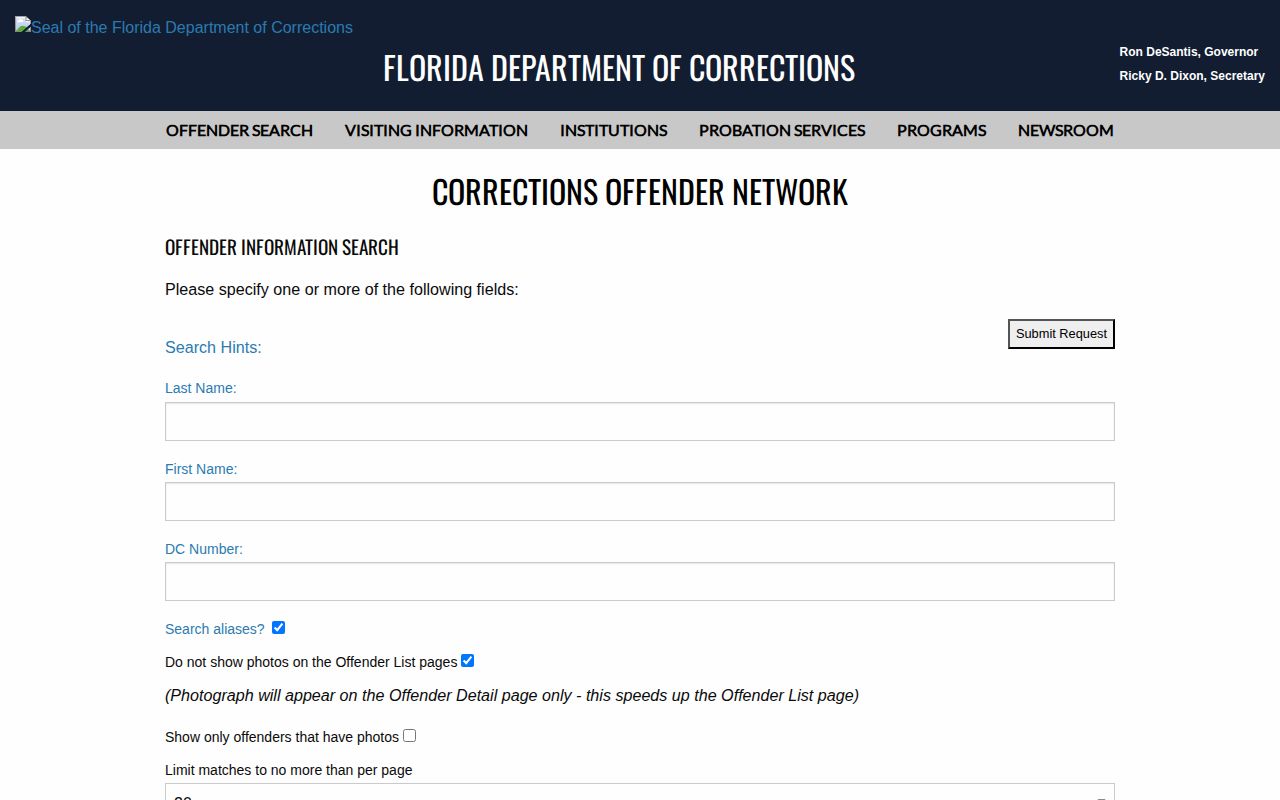
The menu separates active prison, released, supervised, and absconder records. That separation prevents an active date from being mistaken for a completed release.
Note: Search failure may reflect an alias, source limits, record age, a site block, or a different custodian, not proof of release.
FDC Charlotte Release Date Fields
FDC’s Inmate Releases database accepts last name, first name, or a six-character DC number. Name searches use prefix matching, and an alias option can widen the match. FDC says this database contains people already released or scheduled for release, includes photographs, and updates nightly. A released detail observed during the research displayed the page title “Inmate Release Information Detail,” a photograph, DC number, name, race, sex, birth date, custody, Release Date, aliases, and prison sentence history.
Use the DC number when possible. Names can collide, and the database covers a statewide population. Compare the birth date and sentence history before using the date. FDC’s Corrections Offender Network reports that active location, status, and release-date data can change quickly. Active information is generally refreshed weekly, while certain location and release-date changes update nightly. Released records update nightly.
The FDC Inmate Releases search is the released-first source for Charlotte Correctional Institution and other Florida prisons.
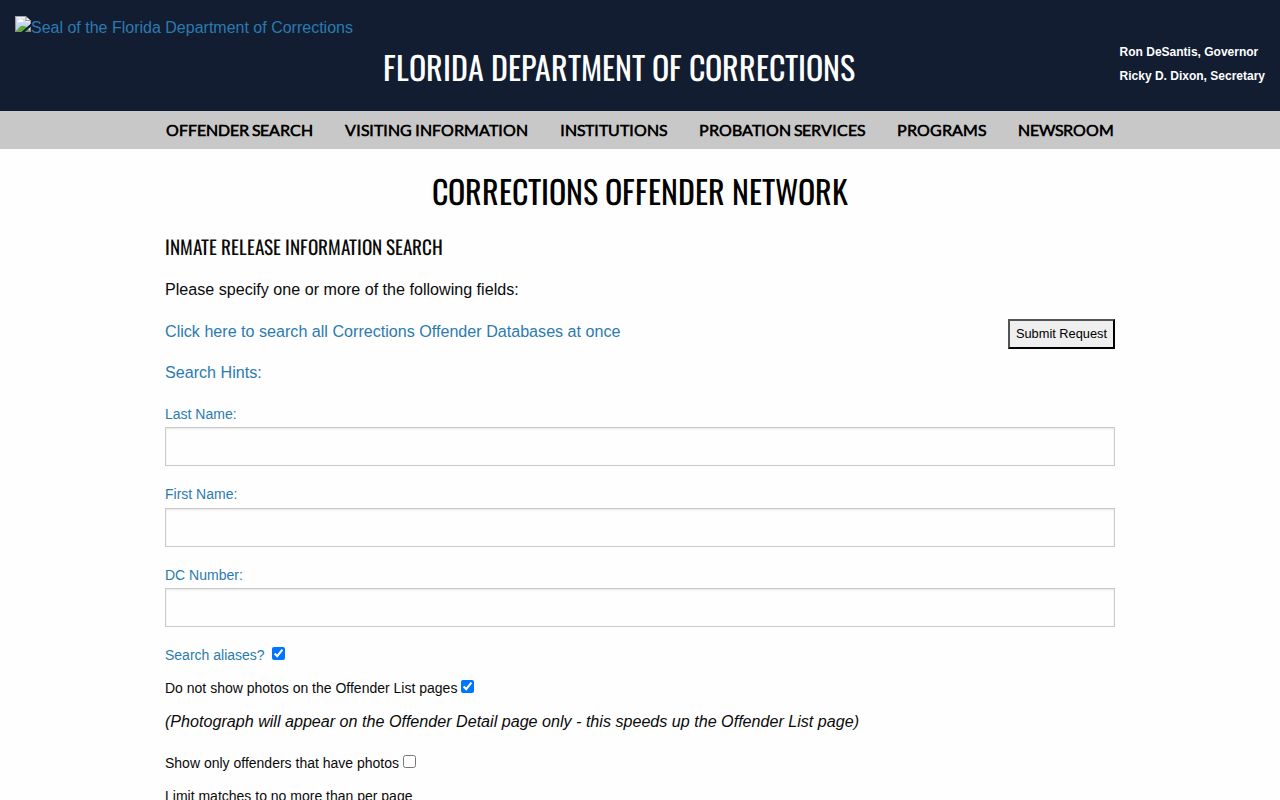
The dedicated form makes clear that released and scheduled records share a database. Open the matched detail and read the date with its custody and sentence context.
Florida Gain Time for Charlotte Releases
Florida Statutes section 944.275 requires FDC to calculate a maximum sentence expiration date and a tentative release date reduced by lawful credits. New awards or restoration of forfeited gain time can move the projection earlier. A forfeiture can move it later. The tentative date cannot extend beyond the maximum sentence expiration date.
For offenses committed on or after October 1, 1995, FDC may grant up to ten days per month of incentive gain time, subject to eligibility and offense exclusions. Section 944.275(4)(f) bars these awards from producing release before service of at least 85 percent of the imposed sentence. Court-awarded credit for physical incarceration counts toward that threshold. Basic gain time under subsection (4)(a) applies only to offenses committed from July 1, 1978 through December 31, 1993.
Section 921.002 reinforces the actual-time rule for Criminal Punishment Code sentences. A sentence can be shortened only through allowed incentive or meritorious gain time and not below 85 percent. Parole under chapter 947 does not apply to people sentenced under the Code. Still, the 85-percent rule is not a promise of release at exactly 85 percent. Offense date, sentence structure, court credit, mandatory minimums, statutory ineligibility, life terms, and discipline can change the result.
The official FDC gain-time statute display shows the law behind the calculation.
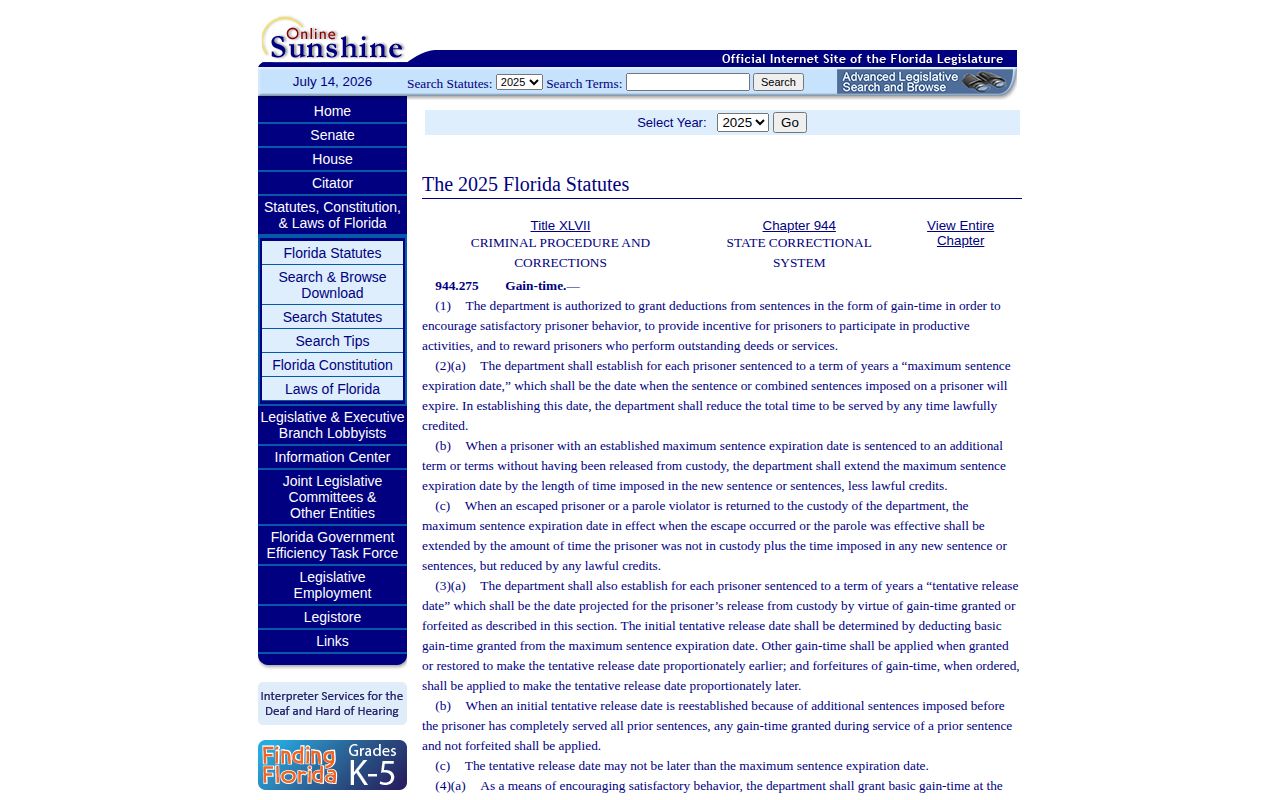
The statute supplies rules, not a do-it-yourself date guarantee. The current FDC record remains the source for the agency’s calculated date.
Charlotte County Jail Gain Time
Charlotte County Jail follows a separate local framework. The 2026 CCSO inmate handout says county inmates may receive five days of state gain time for each 30 days of sentence and five days per month of county gain time for an assigned work role. Awards are made every 30 days. The handout also says gain time may be lost for discipline or refusal to work.
Florida Statutes section 951.21 authorizes county good-conduct and extra good-time policies. It permits up to five days per month during the first two years for good conduct, larger deductions in later years, and up to five additional days per month for meritorious conduct or exceptional industry if adopted locally. Forfeiture is possible. The CCSO handout is the more specific source for Charlotte’s published implementation.
A local sentence calculation should come from CCSO and the signed judgment. Call the Charlotte County Jail at 941-833-6300 or Detention Watch Commanders at 941-833-6357 for the release or transfer paperwork path. Use the Charlotte Clerk criminal record to confirm the sentence, credit, and later court orders. A county jail calculation cannot be replaced with the FDC prison rule.
Note: County gain time and FDC gain time arise under different laws and records, even when both cases began in Charlotte County.
Why Charlotte Release Dates Change
A release date is the output of a live legal record, not a fixed countdown copied from an old screenshot. FDC warns that release dates can change quickly. The county jail also must apply new court orders, holds, bond events, and receiving-agency instructions before it can complete a departure.
| Factor | Possible effect | Where to verify |
|---|---|---|
| Gain-time award or restoration | May move an FDC tentative date earlier within statutory limits | Current FDC record and sentence history |
| Disciplinary forfeiture | May move a prison or county sentence date later | FDC or CCSO sentence calculation |
| Detainer or receiving-agency hold | May turn departure from one facility into continued custody elsewhere | Custodian release reason and receiving agency |
| New or amended court order | May change sentence, credit, bond, or authority to release | Signed court order and Clerk docket |
| Consecutive or additional sentence | Can extend the total custody term | Sentence history and judgment |
| Parole or conditional-release action | May set terms or an effective date but not prove completed release | FCOR order, then FDC release record |
A detainer is a request or notice from another authority tied to custody. It may cause a transfer when the first sentence or local hold ends. That means a Charlotte County Jail release date can mark the end of CCSO custody without marking release to the community.
Charlotte Pretrial Release Has No Projection
A pretrial detainee has no sentence-based projected release date. Release depends on court authority, monetary bond or eligible pretrial supervision, unresolved holds, identity checks, paperwork, and jail processing. The Twentieth Judicial Circuit says processing after a judge orders release usually takes a few hours, typically after monetary bond. That is a local expectation, not a deadline.
A person released to Charlotte Pretrial Services leaves the jail but remains subject to the pending case and court conditions. A person transferred to FDC or another custodian also leaves the county jail without becoming free. Ask for the release reason and any public receiving-agency field. The court record explains the order, while the CCSO release screen documents the physical event.
Confirm Charlotte Inmate Release Dates
Once an expected date passes, search again. For an FDC prisoner, open Inmate Releases and look for a past Release Date, then search Supervised Population to learn whether state supervision follows. A transfer to another FDC prison remains active custody and belongs in the active population record. If a date or result is unclear, FDC lists the Bureau of Admission and Release at 850-488-9167 and dc.release@fdc.myflorida.com, plus Central Records at 850-488-9859.
For Charlotte County Jail, seek a Date Released and Release Reason from the Local Arrest Database or a narrow public-record request. Detention Watch Commanders review booking, release, and transfer paperwork. A certified or copied record may take longer than a phone check, but it provides documentary proof. The Charlotte County release-record search explains the full county, court, state, federal, and ICE proof chain.
Florida VINE can provide an alert on a matched person, but an alert is a prompt to verify. It is not the signed court order or certified release record. The Charlotte VINELink release check explains identity matching and notification limits. Keep the source, date, and status together whenever a release date is recorded.