
Charlotte Parole and Probation
Florida uses several forms of community supervision. Probation and community control come from a court order and are administered by Florida Department of Corrections Community Corrections for qualifying state cases. Probation permits a person to remain in the community under stated terms. Community control is a more restrictive form of supervision. Parole is a discretionary release process handled by the Florida Commission on Offender Review, or FCOR. It now applies mainly to older cases and narrow exceptions because Florida effectively abolished parole for crimes committed on or after October 1, 1983.
Conditional release and other post-prison programs form a third group. They may begin when prison custody ends, yet they are not automatically parole. The exact label matters. A careful verification states what the source proves, such as “released from prison and shown on FDC supervision,” rather than calling every supervised person a parolee.
| Status | Who imposes or controls it | Best verification source |
|---|---|---|
| Probation or community control | Court order; FDC Community Corrections for covered state cases | FDC Supervised Population, the supervising office, and the court docket |
| Parole | Florida Commission on Offender Review | FCOR action or order, followed by FDC custody and supervision records |
| Conditional or other post-prison release | Florida law, FCOR, and FDC according to the case | FDC Inmate Releases plus Supervised Population |
| Pretrial supervision | Charlotte County court process | Charlotte Pretrial Services and the Clerk case record |
- Discharge
- The formal end of the custody or supervision component shown by the responsible agency.
- Absconder
- A person whom the supervising authority reports as unavailable or noncompliant with required location or reporting.
- DC number
- The six-character FDC identifier that gives a more precise match than a name alone.
- Presumptive parole release date
- An FCOR parole-planning decision for an eligible case, not proof that physical release occurred.
Verify Charlotte County Supervision
The FDC Supervised Population search is the main online route for a state-supervision question. Search by DC number when known. Otherwise, use the person’s name and compare birth date and other identifiers. The record may display a supervision begin date, current status, supervision type, current location, scheduled termination date, aliases, and supervision sentence history. A listed street address should not be copied or spread when it is not needed to confirm the status.
The search has a defined scope. FDC covers felony offenders sentenced to state prison or placed on state supervision. It does not replace Charlotte Pretrial Services, every county program, the county jail release record, or the court file. A person can leave Charlotte County Jail under a local order without appearing in this state database.
- Identify whether the release was from Charlotte County Jail or an FDC prison and locate the DC number if one exists.
- Search Supervised Population and match the correct person by more than a shared name.
- Record the supervision type, status, begin date, scheduled termination date, and the date the record was checked.
- Contact the listed or likely circuit office before treating a displayed location as the current assignment.
- Check the Charlotte Clerk case record when the status came from a court order or local pretrial release.
- If parole is involved, obtain the FCOR action or order and then confirm the custody event in FDC Inmate Releases.
The official search screen illustrates the database used for this task. View the FDC supervision lookup source before comparing a record.
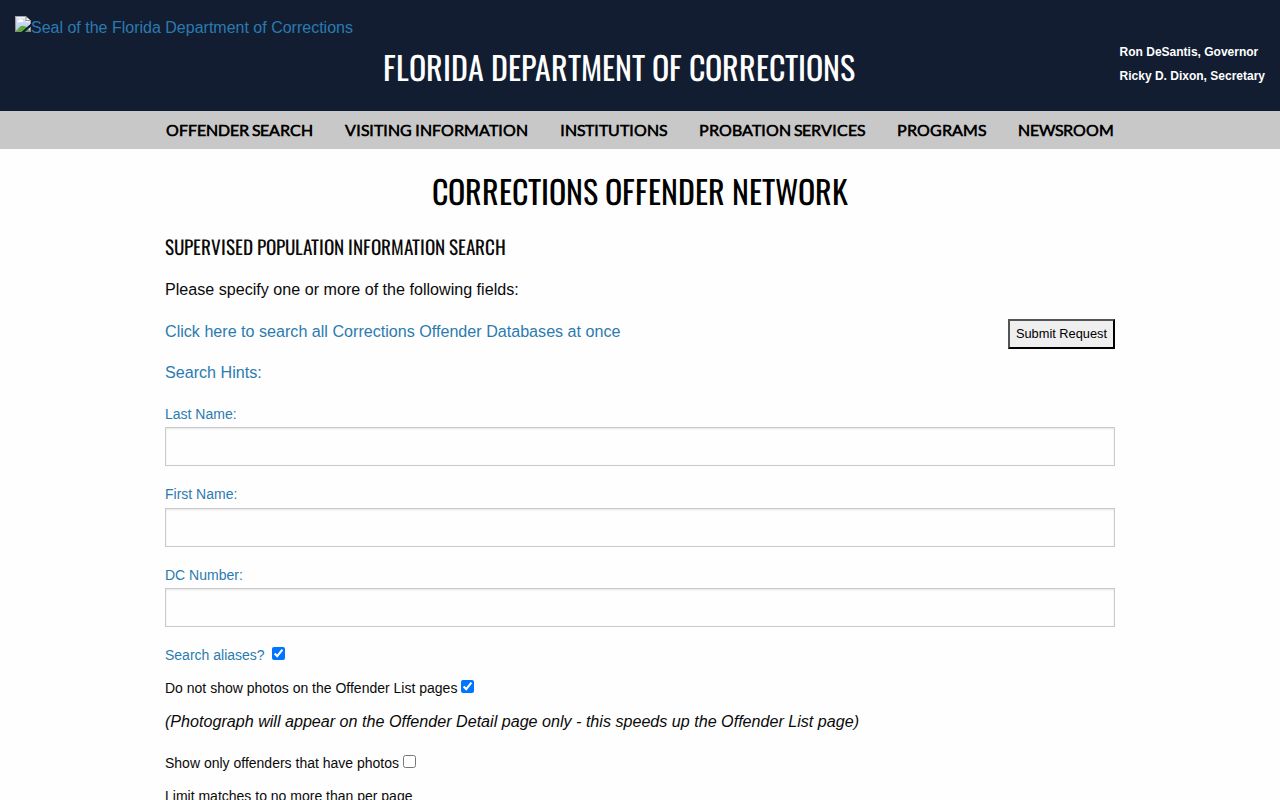
A matched supervision record can confirm that prison custody ended while a sentence component continued in the community. It does not establish that every other case or hold ended.
Note: If the online result conflicts with an office response, preserve both check times and rely on the supervising agency’s current confirmation.
Charlotte Probation Office Details
FDC Circuit 20 serves Charlotte, Collier, Glades, Hendry, and Lee counties. Its official office list identifies the 203 Punta Gorda office, but a person associated with Charlotte County should not be assumed to report there without checking the assignment. FDC also provides a central supervision contact for cases when the correct local office is unclear.
FDC Office 203, Punta Gorda
121 E. Marion Avenue, Suite 125
Punta Gorda, FL 33950-3635
Phone: 941-575-5740
Fax: 941-575-5743
FDC supervision: 850-717-3444
co-supervision@fdc.myflorida.com
The FDC Circuit 20 office list is the source for these details and the circuit’s service area.
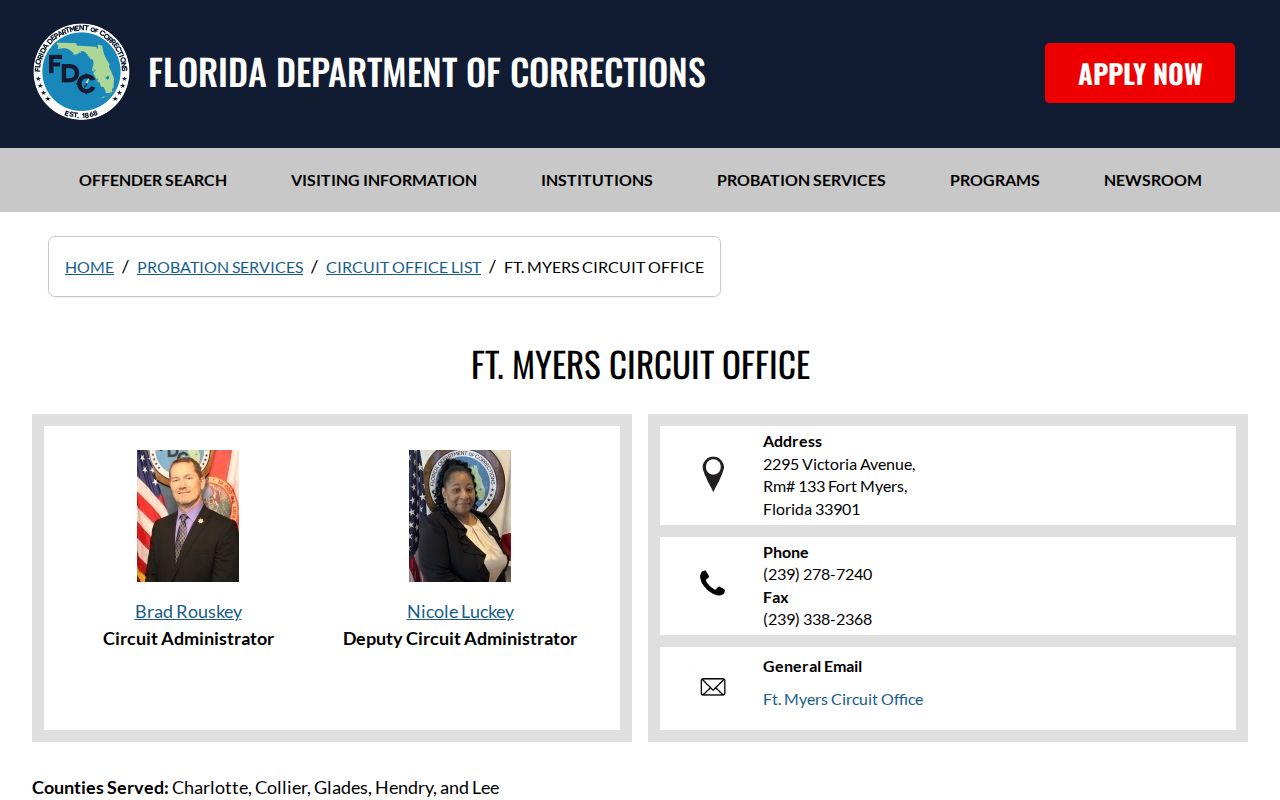
The office listing helps route a verification call. Staff confirmation is still needed before treating this as a specific person’s reporting site.
Charlotte Pretrial Release Supervision
A person released from Charlotte County Jail may be under local pretrial supervision instead of FDC probation. The Twentieth Judicial Circuit explains that eligible people can be released to supervision without posting a monetary bond. The criminal case remains pending, and orientation, reporting, and court-ordered conditions can continue. That status is verified with the local program and court file, not by forcing the name into an FDC parole search.
Charlotte Pretrial Services
Justice Center, first floor
350 E. Marion Avenue, Punta Gorda
Phone: 941-637-2116
Monday-Friday, 8 a.m.-4:30 p.m.
Closed weekends and court holidays
The circuit source publishes inconsistent ZIP information for this location, so the street address should be confirmed before mail is sent. The Charlotte Clerk case portal can add the charge, disposition, probation, judgment, or later order. A closed docket does not itself prove the time of physical release.
Charlotte Supervision and Absconders
Use the FDC Absconder/Fugitive search only when an active supervision record or another reliable fact makes it relevant. An absconder label means FDC reports the person unavailable or noncompliant with location or reporting. It does not prove a new conviction. The search should not be used as a broad wanted-person list, and a release from jail does not settle a separate warrant question.
The FDC Absconder/Fugitive database uses a separate record set from Supervised Population.
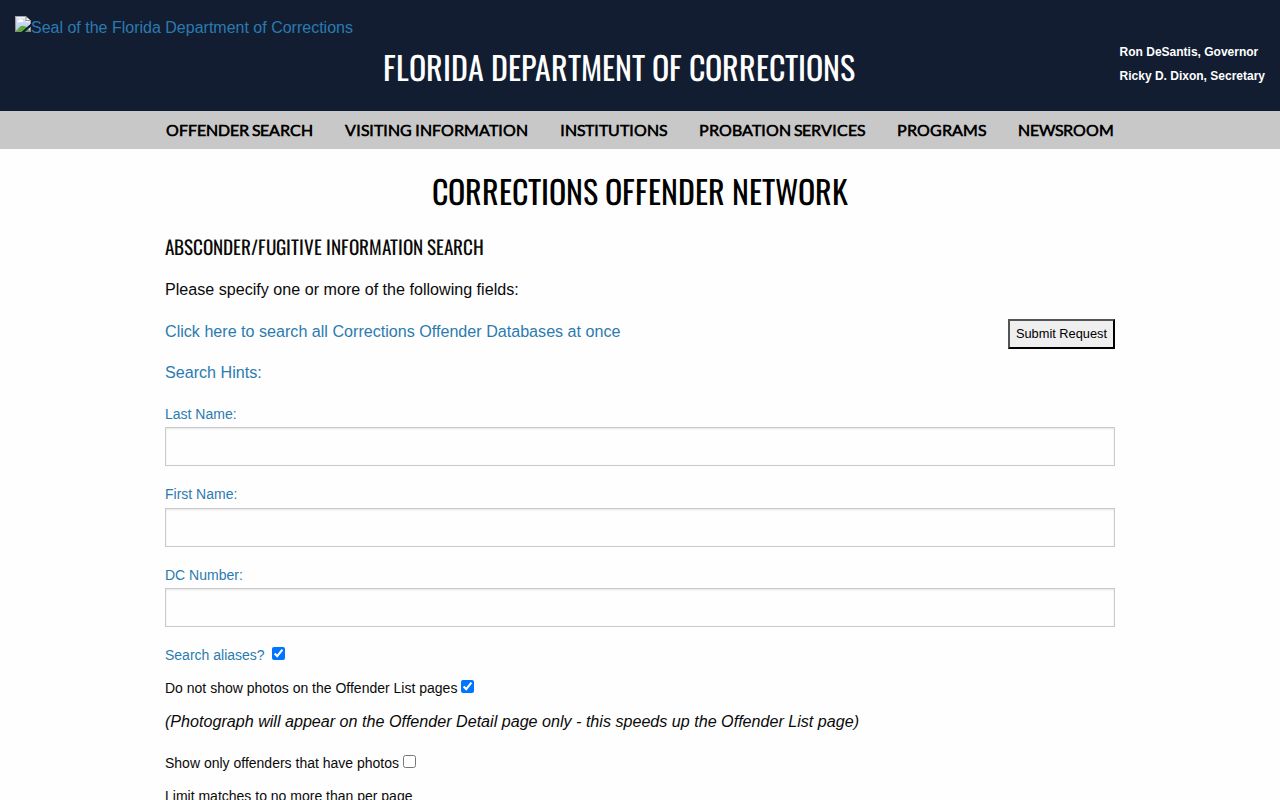
This separate screen reinforces why a normal supervision match and an absconder result should not be treated as the same status. FDC lists its Absconder Unit at 850-717-3475 on weekdays from 8 a.m. to 5 p.m.
Charlotte County also maintains an official warrants portal and warrant inquiry form. The inquiry form warns that a response may take up to seven business days and that CCSO is not obligated to provide warrant information through that form. Those terms apply to the warrant inquiry, not to an ordinary public-record request.
Note: Report the source’s exact status and date checked; do not turn an absconder flag or warrant inquiry into a broader claim.
Charlotte Parole Hearing Records
FCOR controls Florida parole decisions. Most modern prison cases concern gain time, sentence expiration, conditional release, or another statutory route rather than parole. For cases that remain parole-eligible, section 947.16 sets interview timing by sentence length and mandatory minimum. The person is advised of a presumptive parole release date after the interview process, but eligibility, an interview, or an agenda entry is not a grant of release.
Start with the FCOR Commission Voting Schedule, then open the interactive schedule by name or DC number. Agenda categories describe the kind of action, such as an initial interview, effective interview, parole final hearing, supervision review, or conditional release matter. Research found no official public decision-search page or vote-result field. Obtain the Commission action or order from FCOR public records at fcorlegal@fcor.state.fl.us or 850-848-4460 when the result matters.
A favorable action may still carry an effective date, terms, a detainer, or a chance of rescission. Confirm physical release later in FDC Inmate Releases and confirm continuing supervision in Supervised Population.
Charlotte Supervision Discharge Records
Supervision ends through the legal process that governs it. A scheduled termination date on an FDC record is useful, but it should not be treated as final if the record can change. Search again after that date and contact FDC when a firm discharge status is needed. FCOR controls commission action for parole and related matters, while the court docket controls probation orders and termination in a court case.
A sound proof chain uses the custody record and the supervision record together. FDC Inmate Releases can show the prison release date. Supervised Population can show whether state community supervision began or remains active. The court file can explain probation or a local pretrial order. The Charlotte County released inmate search and records overview covers county jail, state prison, federal, and ICE routes when the original custodian is uncertain.
Florida VINE can send notice of custody and some supervision changes, but it is not a certified discharge record. An alert should prompt a new check with FDC, FCOR, the court, or CCSO as the case requires.
Property After Charlotte Release
Supervision verification is not the only task after a Charlotte County jail departure. The CCSO inmate handout says personal property is inventoried during booking and may be released through a notarized form. If the person is sent to FDC, family has 90 days to retrieve property. CCSO also says a commissary order not received before release is held for 30 days.
These are custody-property deadlines, not probation conditions. They belong with the jail’s property process even when the person begins supervision after release. Call the Charlotte County Jail at 941-833-6300 before traveling or preparing a notarized form because the published research does not identify a separate fixed release-property window. A transfer to FDC also changes which agency controls the person while the county may still hold stored belongings.
Note: A property pickup deadline does not prove discharge from supervision; verify the legal status through the agency that controls the sentence.