
Charlotte County Same-Day Releases
Charlotte County Sheriff’s Office publishes one Local Arrest Database. The mandatory source sweep found no separate page labeled as a 24-hour release list, and CCSO does not state a rolling window, update cadence, or online retention term. The embedded bookings application is still the right first stop. Search the matched booking and look for an affirmative release date and release reason. Do not sort recent arrests and call the result a release list. Someone booked today may remain in custody, while someone released today may have entered the jail weeks earlier.
The database host blocked the research session even though the CCSO wrapper loaded. That access issue makes a second route essential. Detention Watch Commanders review booking, release, and transfer paperwork and can be reached at 941-833-6357. The general jail number is 941-833-6300. Phone staff may limit what they disclose, and a call is not a certified record, but the call can clarify whether paperwork has finished and whether departure was a release or transfer.
Check Charlotte County 24-Hour Records
Use an exact 24-hour interval, including start and end times. The official interface must offer a true release-date control before it can be used as a windowed list. A booking-date filter answers a different question. If the live application does not expose a release-date range, move to the phone or records route instead of inferring from booking time.
- Open the CCSO Local Arrest Database and follow its embedded bookings link.
- Inspect the current controls for a released-record option and an actual release-date filter.
- Open each plausible booking. Match the full name with birth date or booking date, then record the release date and reason.
- If the application blocks access or lacks a release-date range, call a Detention Watch Commander with the name, date of birth if known, and booking date or JCA.
- For documentary proof or a complete interval, submit a narrow request through the CCSO public-record portal.
A named-person search may also need the court docket, FDC, or another custodian. The full source decision path appears on the Charlotte County released-inmates search. A same-day list should stay focused on release events from the county jail, not every record held by another system.
Charlotte County Release Fields
Exact current labels must be checked in the live CCSO result. The official capture available for this project shows the released-result area, while the research treats several secondary field observations as provisional. The strongest proof is an agency record with both the event time and its reason.
| Field | What it helps confirm |
|---|---|
| Name and birth details | Whether the booking belongs to the intended person rather than a namesake. |
| Booking or JCA | The distinct jail episode tied to the requested interval. |
| Date confined | When county custody began, not when it ended. |
| Date and time released | Whether departure falls inside the exact 24-hour window. |
| Release reason | Bond, time served, dismissal, pretrial release, or a transfer route. |
| Transfer destination | Whether another agency took custody instead of community release. |
The official embedded booking database is illustrated below. The image documents the released-result and photo area, not a guaranteed rolling feed.
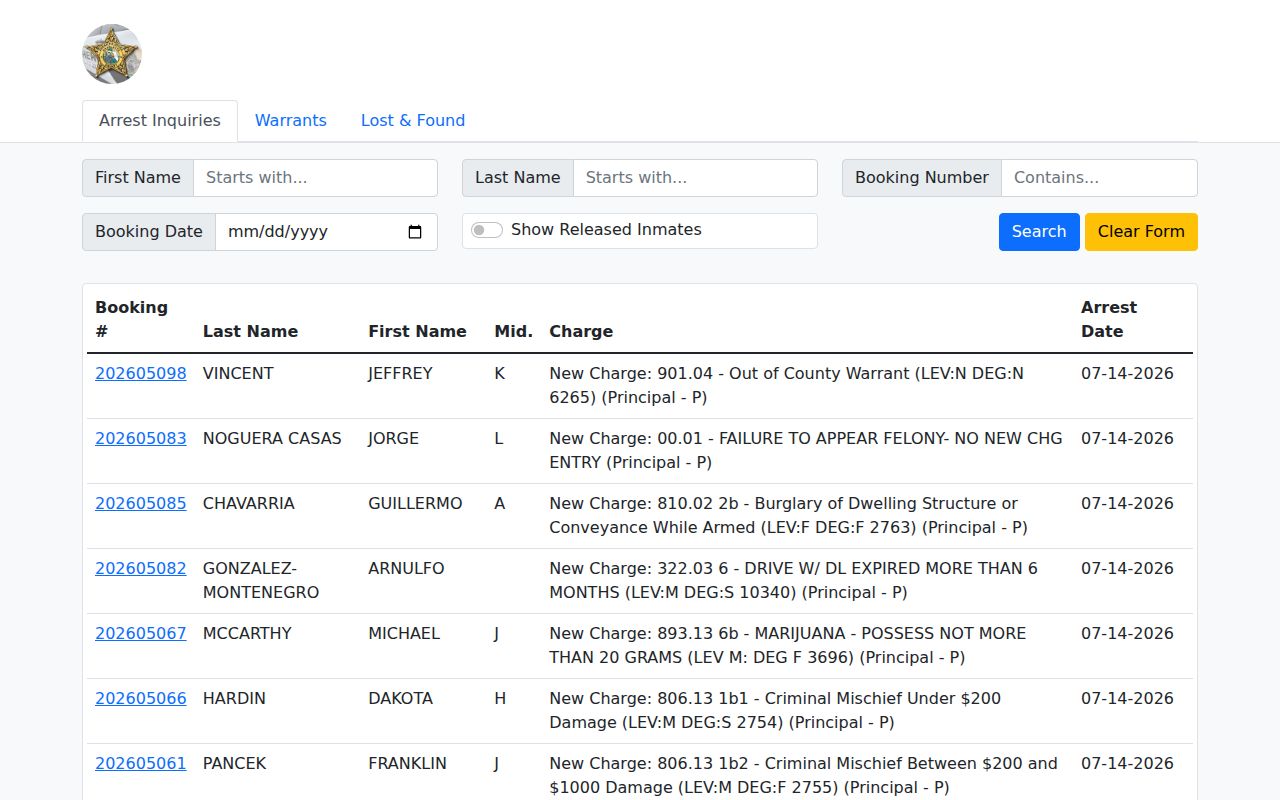
Confirm the date field in the live record and pair it with the release reason before counting the event.
Request Charlotte County Release Records
When no verified online window exists, ask for an existing release log or report covering a precise interval. A useful request seeks records showing people released from Charlotte County Jail between the stated start and end times, including release date, release time, and reason, while excluding exempt information. Florida public-record law does not require CCSO to create a new analytic report if no such record exists. Extraction or redaction may also lead to a fee estimate.
Submit through the CCSO JustFOIA portal. Keep the request narrow and preserve its request number. If a list cannot be produced, request the release screen for a named person with the full name, birth date if known, booking or JCA, and arrest date. Ask for the confined and released times, reason, public transfer destination, charge and bond fields, and booking photograph. CCSO publishes no guaranteed ordinary-request turnaround, so ask for acknowledgement, a cost estimate, and a target production date.
For a wider interval designed to catch weekend events, use the Released Last 72 Hours process. That page uses the same official sources but deals with duplicate bookings, delayed entries, and holiday timing.
Charlotte County Release or Transfer
“Released” must be tied to the custodian. Bond and court-approved pretrial release normally mean the person left the jail while the criminal case stayed open. Time served may mean the local jail term ended, but the signed judgment confirms the sentence. A transfer to FDC, another county, USMS, or ICE means Charlotte County Jail stopped holding the person while custody continued elsewhere.
| Observed fact | Best next source |
|---|---|
| Still shown in current jail custody | CCSO database or detention staff |
| Release date plus bond or pretrial reason | Charlotte Clerk docket for the pending case and conditions |
| Transfer to state prison | FDC active inmate search, not the county release list |
| Release alert without reason | CCSO release record and the appropriate receiving custodian |
Florida VINELink can send a status alert for a matched person, but it is a notification service rather than the certified release record. An out-of-custody notice can follow a transfer. For a state-prison event, use FDC Inmate Releases. Those routes should not be folded into the county’s same-day count.
Note: Record the date and time checked because the Charlotte County database is dynamic and has no published web-retention term.
Charlotte County Release Processing Time
The Twentieth Judicial Circuit Pretrial Services page says processing after a judge orders release usually takes a few hours, typically after monetary bond. That local statement is not a gate-time promise. Bond receipt, identity checks, paperwork, other cases, holds, and a receiving agency can delay or change the event. Call detention to learn whether release paperwork is complete.
A monetary bond payment starts a process; it does not prove that the person walked out. Eligible release to pretrial supervision can occur without posting monetary bond. Both routes can end physical jail custody while the case and court conditions continue. CCSO accepts bond funds through TouchPay and the jail kiosk, yet the payment record alone should never be counted as a completed release.
Charlotte County Bond Release Paths
Charlotte’s official pretrial page separates monetary bond from release to pretrial supervision without posting bond. Both can end jail custody, but they create different records and neither ends the criminal case. A bond entry should be paired with completed release paperwork. A pretrial release should be checked against the court order and the supervision instructions given to the person.
Payment through TouchPay or the jail kiosk is a funding route only. It does not show that all holds cleared, identity work finished, or detention staff completed the release. For a same-day list, count the event only when the booking record or detention confirmation supplies the release date and reason. Then use the Clerk docket when the pending case or conditions need legal context.
Getting Home After Charlotte Release
Pretrial Services says the released person is afforded a jail phone call to arrange transportation. Charlotte County Transit is fare-free, shared-ride, curb-to-curb service. It is not a fixed bus route and not an on-demand jail shuttle. A rider must confirm that the jail pickup and destination fall within the service area, and advance booking is recommended.
Charlotte County Transit operates Monday through Friday from 6:30 a.m. to 6 p.m. and Saturday from 9 a.m. to 6 p.m. It is closed Sundays and recognized holidays. Same-day space may exist, but it depends on availability. Reservations use 941-575-4000. This timing is one reason a release order and a completed ride home should be treated as separate facts.
Charlotte Sheriff App Release Limits
CCSO has official iOS and Android apps. The agency’s 2019 announcement advertised recent arrests, while current accessible store material did not verify an inmate-release feed or mugshot module. The apps therefore cannot be presented as a current Charlotte County 24-hour release source. Recent arrests and releases answer different questions.
The current Charlotte County Sheriff Android listing is shown below. Its existence confirms the official app, not a released-person function.
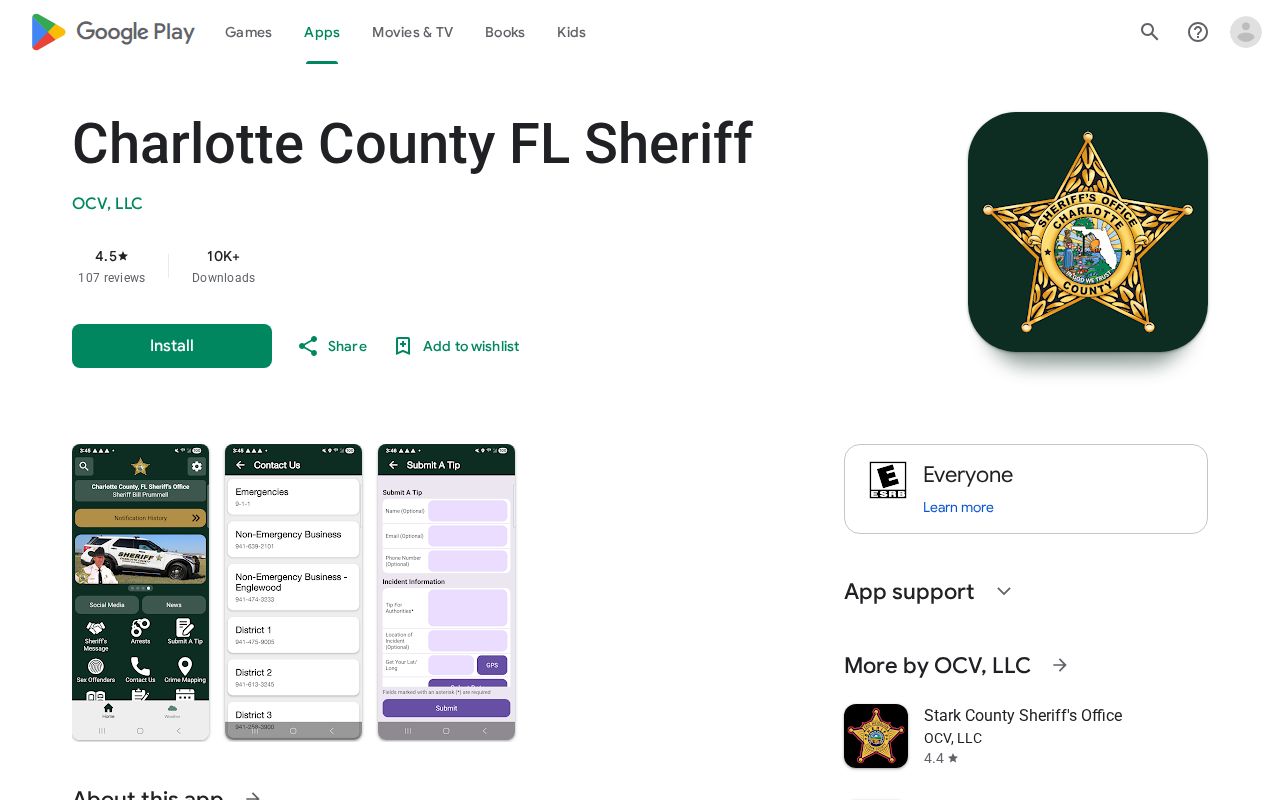
Use the Local Arrest Database, detention phone line, and JustFOIA until a present app screen proves a true release feature.
Current store descriptions emphasize public-safety information and alerts. They do not supply the release date, reason, or receiving-custody fields needed for a same-day list. Even if a future app screen displays a photo or arrest entry, the event must still be checked against the official booking and release record. This keeps a current arrest from being mistaken for a completed Charlotte County release.
The same rule applies to a social post or push alert. A public-safety notice can point toward an arrest, but it does not establish when detention staff closed the booking or where the person went. For a Charlotte County 24-hour count, save the booking identifier, release time, and recorded reason. If the fields conflict, ask the records custodian for the release screen rather than choosing the faster source.